Terminology
The Terminology screen browses the coded vocabularies the CDR can answer questions about: which terminologies it serves, what a code means, which codes a value set holds, whether a given code is one of them, and whether one code subsumes another. Everything on it is a read of the CDR’s public API; nothing is stored on the viewer’s side.
Note
The terminology API is this server’s own extension. openEHR’s REST release publishes no terminology contract, so the operations, URLs and JSON envelopes are this server’s own design over the openEHR TERM specification. A different openEHR server will not serve them.
Switching it on
The surface is opt-in and off by default. While it is off the CDR answers its terminology routes as if they were not mounted, and the screen says so in one card instead of pretending to work:
[api]
terminology = true```
or, as an environment override, `FERROEHR__API__TERMINOLOGY=true`.
Turning it on exposes only lookups over terminologies the server already holds:
the bundled openEHR terminology plus the external code sets beside it. Wiring
the FHIR terminology server is a separate setting, and it changes what
these lookups can answer; both are covered in
[Terminology servers](../beyond-core/terminology.md).
## The terminologies
**Terminologies**, the first of four tabs, lists exactly what the CDR reports:
the internal `openehr` vocabulary and the external code sets beside it
(languages, countries, character sets, media types). A row opens the
terminology's descriptor: publisher, identifying URI, version, and the fields
an extract may ask for, with links to look a code up in it and to expand one
of its groups. Fields the server does not publish are left out.
## Look up
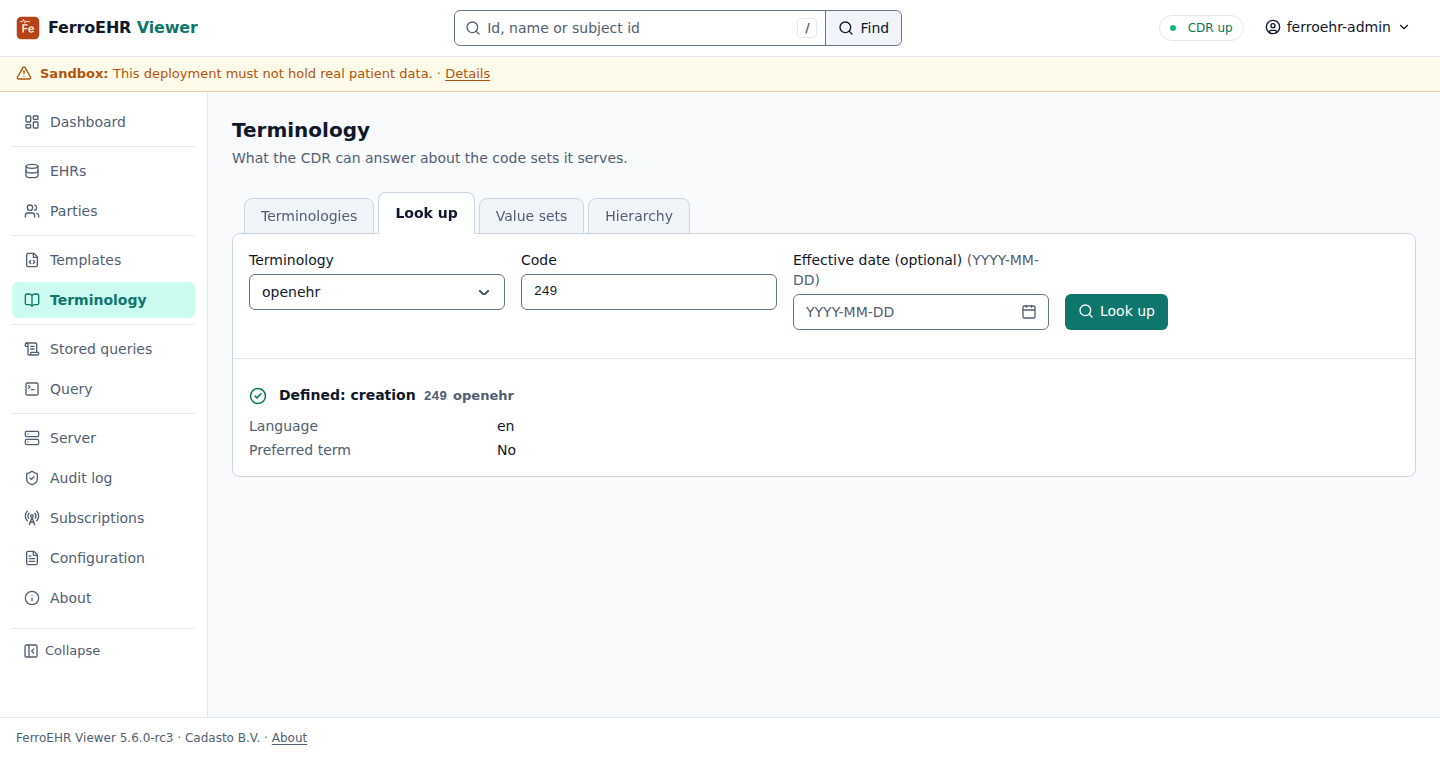
Pick a terminology, type a code and **Look up**. A defined term comes back with
its text, the language it is written in and whether it is the preferred term.
An **effective date** is optional: supplied, it asks for the definition as it
stood that day; the openEHR bundle is one pinned release, so a date changes
nothing there, while an external terminology server can answer differently.
A code the terminology does not define is an answer, not an error: the page
says so, naming the code and the terminology.
> [!NOTE]
> openEHR terminology codes are scoped to their group: `532` is `complete` in
> one group and `completed` in another. A lookup reads the `openehr`
> terminology as flat and returns the first group's rubric, so expand the
> group under Value sets whenever the group matters.
## Value sets
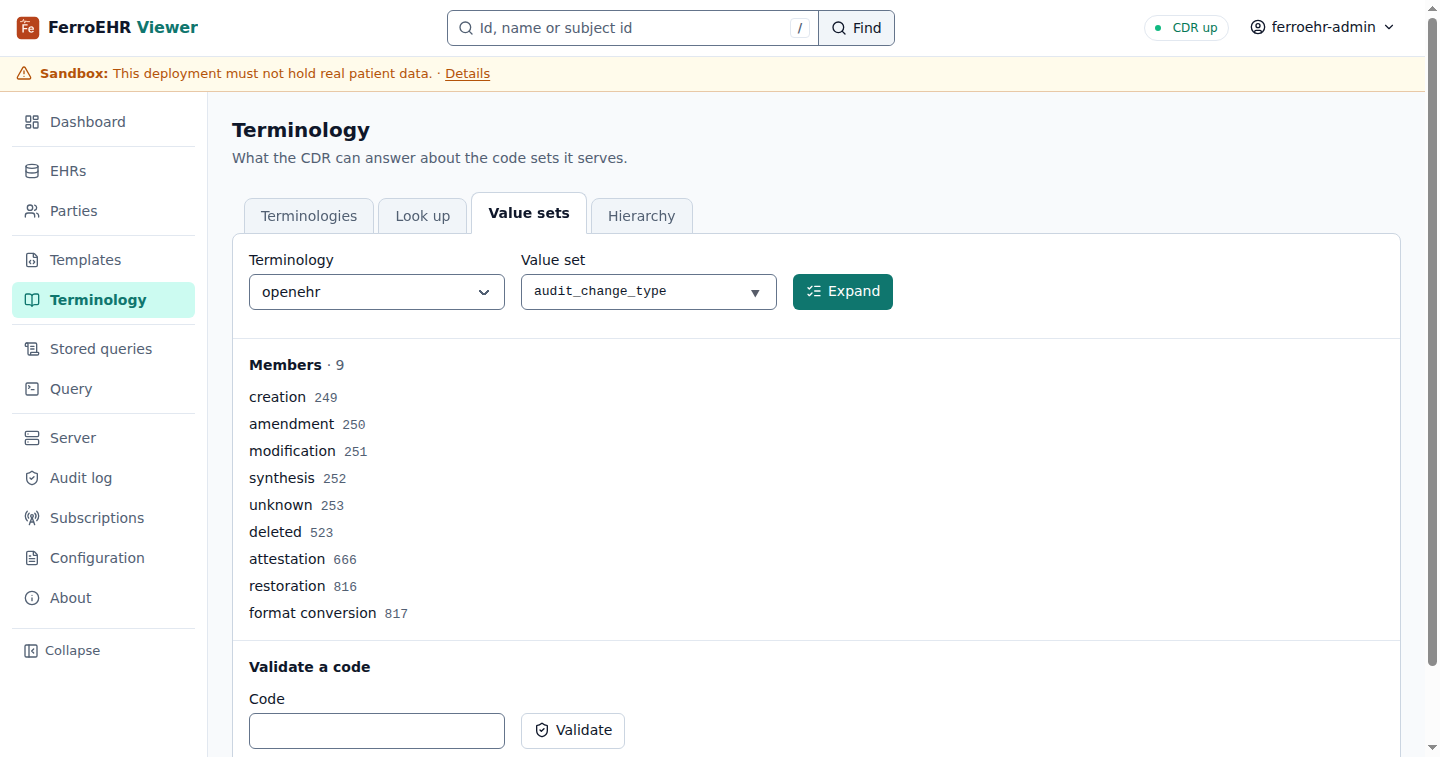
Pick a terminology and a value set (for `openehr`, a vocabulary group such as
`audit_change_type`, offered as you type) and **Expand** it into its members.
Under them, **Validate** answers whether a code is a member, as a sentence
either way; a value set the CDR does not know has no members.
## Hierarchy
**Test** asks whether one code is broader than another. The test is strict,
so a code is never broader than itself, and the openEHR vocabulary defines no
hierarchy, so for any two openEHR codes the answer is no; the page says why.
Hierarchical answers come from an external terminology server when one is
bound.
Every tab is a GET form: the question stays in the address, so an answer is
shareable, and every tab works with JavaScript off.
## In the query builder
A condition on a coded text in [Build](queries.md#build) offers the codes the
template allows as a select, so a coded criterion is never typed from memory;
the query carries the bare code.